
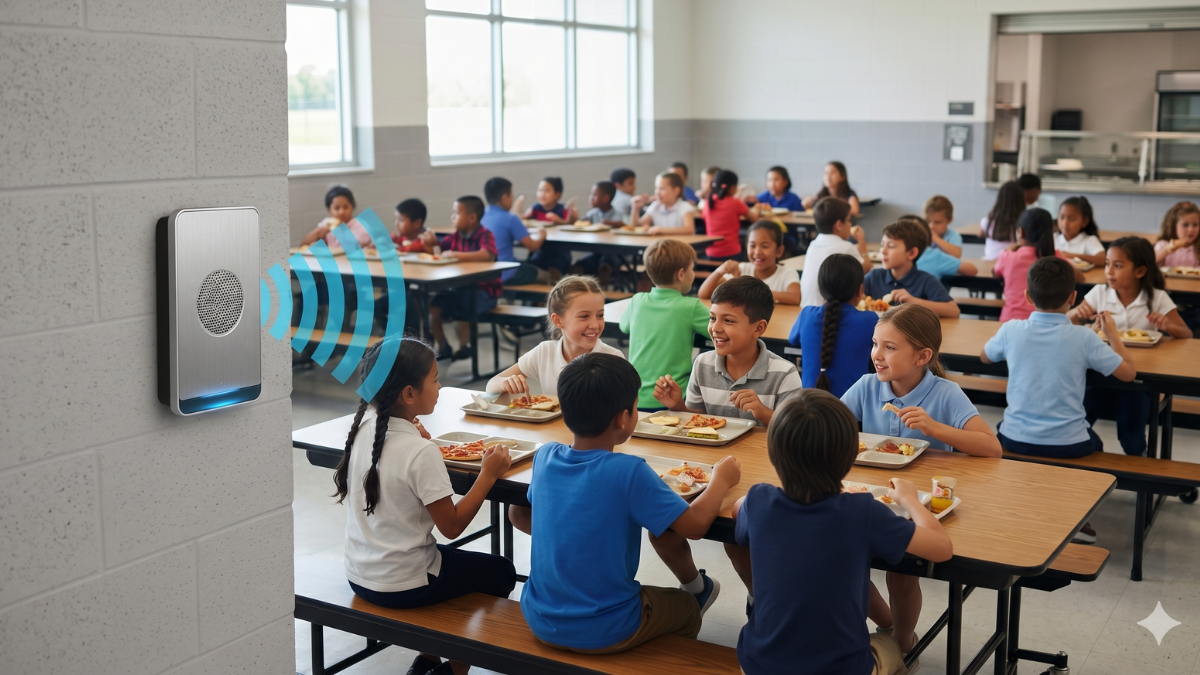
It’s 12:15 p.m. in a crowded cafeteria. Hundreds of voices overlap, chairs scrape, and trays clatter. The room is a wall of sound, sitting at roughly 85 to 90 dB of ambient noise. Then, a lockdown announcement triggers from a wall-mounted speaker.
No one moves.
Not because they are ignoring the alert, but because the alert is effectively "underwater." In school safety, when an alert is not understood, it isn't just a glitch—it’s a liability.
1. The "Broken Wire" and the Student Texting Fallback
Many districts believe their PA systems are "fine" because they work in an empty hallway. But as the 2024 research into the Hillhouse High School "Code Red" incident revealed, a lack of functional audio creates a dangerous information vacuum. When their legacy PA system failed, students on the second floor were left as "sitting ducks," only learning of the danger through frantic text messages from peers on the first floor.
Relying on a student’s data plan to broadcast a life-saving alert is not a security strategy; it is a surrender. At NIC Partners, we see this "compliance paradox" daily: districts spend millions on hardened doors but leave the "digital layer" of communication to chance.
2. The Science of Clarity: Audibility vs. Intelligibility
To understand why audio fails, we have to look at the physics of the "Dead Zone." Loudness is not the same as clarity.
- Auditory Masking: When the background noise (the cafeteria) is nearly as loud as the speaker, "masking" occurs. As a practical rule, an alert needs to be 10 to 15 dB higher than the ambient noise floor to be intelligible.
- The Speech Transmission Index (STI): Measured under the international standard IEC 60268-16, the STI determines if a listener can actually decipher consonants and vowels. High-reverberation spaces like gyms "smear" audio, turning a life-saving instruction into indecipherable noise.
- The Inverse Square Law: Physics dictates that sound pressure levels drop as you move away from the source. Sound intensity decreases with the square of the distance from the source. As a result, doubling the distance reduces the sound pressure level by approximately 6 dB.
3. The Human Cost: The "Seven-Hour Vacuum"
The failure of communication doesn't end when a threat is neutralized. The Marjory Stoneman Douglas High School Public Safety Commission highlighted the "seven-hour vacuum"—a total meltdown in information sharing during family reunification.
When official channels are silent or garbled, parents are forced to find out their children’s fates through social media. Clear, intelligible communication isn't just a tactical need during the event; it is a requirement for the secondary trauma phase of reunification.
4. Closing the Gap: Verkada's Integrated Audio Solution
Modern school safety requires moving past the "rusted 20th-century wires" of legacy PA systems. NIC Partners integrates Verkada’s Unified Command to ensure your message is heard, understood, and seen:
- Clarity at High SPL: Verkada’s Horn Speakers (Basso) and Intercoms are engineered to cut through high-decibel environments without the "muddled" quality of traditional analog systems.
- One-Tap Pre-Recorded Announcements: Eliminate the "mumbled live page." With Verkada, admins can trigger crystal-clear, pre-recorded instructions across the entire campus (or specific zones) with a single tap.
- The Digital Infrastructure Layer: Following the PASS Guidelines v7, Verkada devices are "hardened" against the cybersecurity risks that plague older IP systems. You don't just get a speaker; you get a secure, encrypted communication node.
- Visual-Audio Fusion: In areas where audio masking is a physical certainty (like band rooms or shops), Verkada integrates with Visual Alerters so the message is "seen" when it can't be "heard."
5. Assessments: Turning "We Think It Works" Into Proof
District leaders are often asked to stand behind safety decisions. "Hope" is not a plan, and a basic PA test in an empty building is not proof of readiness.
Through a Campus Safety Technology Assessment, NIC Partners performs objective STI (Speech Transmission Index) testing. we measure the ambient noise floor of your cafeteria during peak lunch hours and the reverberation of your gyms to identify communication dead zones before they become a liability.
Validate Your Emergency Communications Readiness
If you haven't tested intelligibility under real-world conditions, you may not know where your biggest risk lies.
