

Introduction: A Law Worth Understanding Clearly
California’s Senate Bill 848, the Safe Learning Environments Act, has generated a lot of conversation across K-12 leadership circles. It has also generated a lot of confusion. Some districts are treating it as a sweeping mandate that requires immediate, large-scale change. Others have not yet engaged with it at all. Most are somewhere in between, working to understand what the law actually says, what it actually requires, and what falls outside its scope.
This guide is written for K-12 administrators, business officials, and technology leaders who want a clearer picture of SB 848 without the marketing spin. It explains what the law does, where its requirements stop, and how the broader conversation about campus supervision technology has evolved alongside it.
This is not legal guidance. Districts should consult their own legal counsel and JPA risk pools for compliance advice. This guide focuses on the educational and technological context that informs those conversations.
What SB 848 Actually Is
SB 848 is a California state law passed in 2025 that focuses on preventing child abuse and employee misconduct in K-12 schools. It is part of a broader legislative response to the financial and ethical pressures facing California districts following AB 218 and AB 452, which together expanded statute-of-limitations windows and exposed schools to significant historical liability.
At its core, SB 848 addresses three areas:
- Employment practices for non-certified (classified) school employees, including disclosure requirements and inter-district information sharing
- Professional boundary policies that districts must adopt regarding adult-student communication
- Facilities and supervision policies that promote safe and easily supervised environments on school campuses
Each of these areas has a different effective date, a different scope, and a different set of stakeholders inside a district. They are often discussed as a single mandate, but they are not. Understanding them separately is the first step to engaging with SB 848 thoughtfully.
What SB 848 Is Not
Equally important is what SB 848 does not do.
- It does not prescribe specific technology. The law does not require any particular camera system, communication monitoring tool, or sensor. It does not name vendors, products, or platforms. Districts retain full discretion over how, and whether, to use technology in their supervision strategy.
- It does not create a real-time compliance audit. SB 848 does not establish an inspection regime or grading rubric. There is no state body that will arrive to score a district’s safety posture against the statute.
- It does not replace existing student safety laws. SB 848 layers on top of California Education Code requirements, mandated reporter law, Title IX obligations, and local board policies. It supplements; it does not supersede.
- It does not require a single, unified policy. Districts can address different provisions of SB 848 through different policy instruments at different times, subject to the effective dates set in the statute.
For district leaders, the practical implication is that SB 848 creates a framework for conversation rather than a checklist. The substance of how a district responds remains, as it has always been, a local decision shaped by counsel, board direction, and community context.

The Broader Context: Why Campus Safety Is Being Re-Examined
SB 848 did not emerge in a vacuum. Several converging factors have pushed campus safety from a periodic policy review item into an ongoing leadership priority.
-
Expanded liability windows. AB 218 and AB 452 have meaningfully changed the time horizon over which districts may face claims related to historical misconduct. This has made record-keeping practices, evidence retention, and incident documentation more consequential than they have historically been.
-
Shifts in how misconduct occurs. Research on grooming behaviors, including widely cited work by Charol Shakeshaft, has documented that a significant share of educator misconduct cases involve inappropriate communication between adults and students. Much of that communication today happens on digital platforms outside the traditional school environment.
-
Changes in supervision expectations. The reasonable expectations of supervision on a modern K-12 campus have changed. Districts now operate larger facilities, with more entry points, more digital interaction, and more public scrutiny than in prior generations.
-
Resource constraints. Most districts are addressing all of the above with flat or declining staffing, smaller administrative teams, and limited bandwidth for ongoing manual oversight.
These pressures are real regardless of any single piece of legislation. SB 848 is, in many ways, a recognition by the legislature that the operating environment for K-12 districts has changed.
How Campus Supervision Technology Has Evolved
Independent of any specific law, the technology landscape for K-12 campus supervision has changed substantially over the past five to seven years. Districts that have not surveyed the landscape recently may find that several long-standing assumptions no longer apply.
None of these technologies are required by SB 848. All of them, however, are part of the broader conversation that K-12 leaders are having about how to deliver modern campus supervision.
Four Areas Where Many Districts Are Focusing Attention
Across conversations with district leaders, four supervision categories are coming up repeatedly. They map closely to the practical concerns that SB 848 highlights, though they predate the law and would matter regardless of it.
1. Visibility
How well can a district see what happens on its campuses, in real time and after the fact? Visibility includes camera coverage, retrieval speed, and the ability to reconstruct a timeline when something is alleged to have occurred.
2. Digital Boundaries
How does a district monitor and govern the communication that happens on its issued devices and accounts? This is not about surveilling students. It is about ensuring that the channels a district owns are used in ways consistent with district policy and the law.
3. Private Space Detection
How does a district provide reasonable awareness in spaces where cameras cannot be placed? This is one of the harder questions in modern supervision, and one where technology has changed meaningfully in recent years.
4. Evidence Integrity
When something does occur, can the district produce a clear, defensible, time-stamped record? This is increasingly the dividing line between incidents that resolve cleanly and incidents that become protracted, expensive, and reputationally damaging.
These four areas are useful as a self-reflection framework. They are not a checklist, and they are not pulled from the text of SB 848. They are simply the questions that thoughtful K-12 leaders are asking right now.
 Common Misconceptions
A few patterns come up frequently in conversations about SB 848. Each is worth addressing directly.
-
“SB 848 requires us to install cameras everywhere.” It does not. The law speaks to supervision policy, not to specific surveillance hardware.
-
“SB 848 requires us to monitor student communication.” It does not. The law addresses adult-student communication and the policies districts must adopt around it. It does not mandate any specific monitoring tool or practice.
-
“SB 848 will be enforced through audits.” The law does not establish a routine inspection regime. It does, however, create expectations that may become relevant in the context of litigation or insurance review.
-
“We have until 2027 because of the database.” The CTC database is a 2027 item and is contingent on legislative funding. The professional boundary and supervision policy provisions have earlier effective dates and operate independently.
-
“Our existing policies already cover this.” Possibly. Many districts find on review that their existing policies cover some provisions of SB 848 but not others. A policy review with counsel is the most reliable way to know.
Districts should be cautious about both over-reaction (treating SB 848 as a sweeping mandate that requires immediate replacement of every system) and under-reaction (assuming nothing has changed). The reality, as usual, sits between those poles.
Questions K-12 Leaders Are Asking Themselves
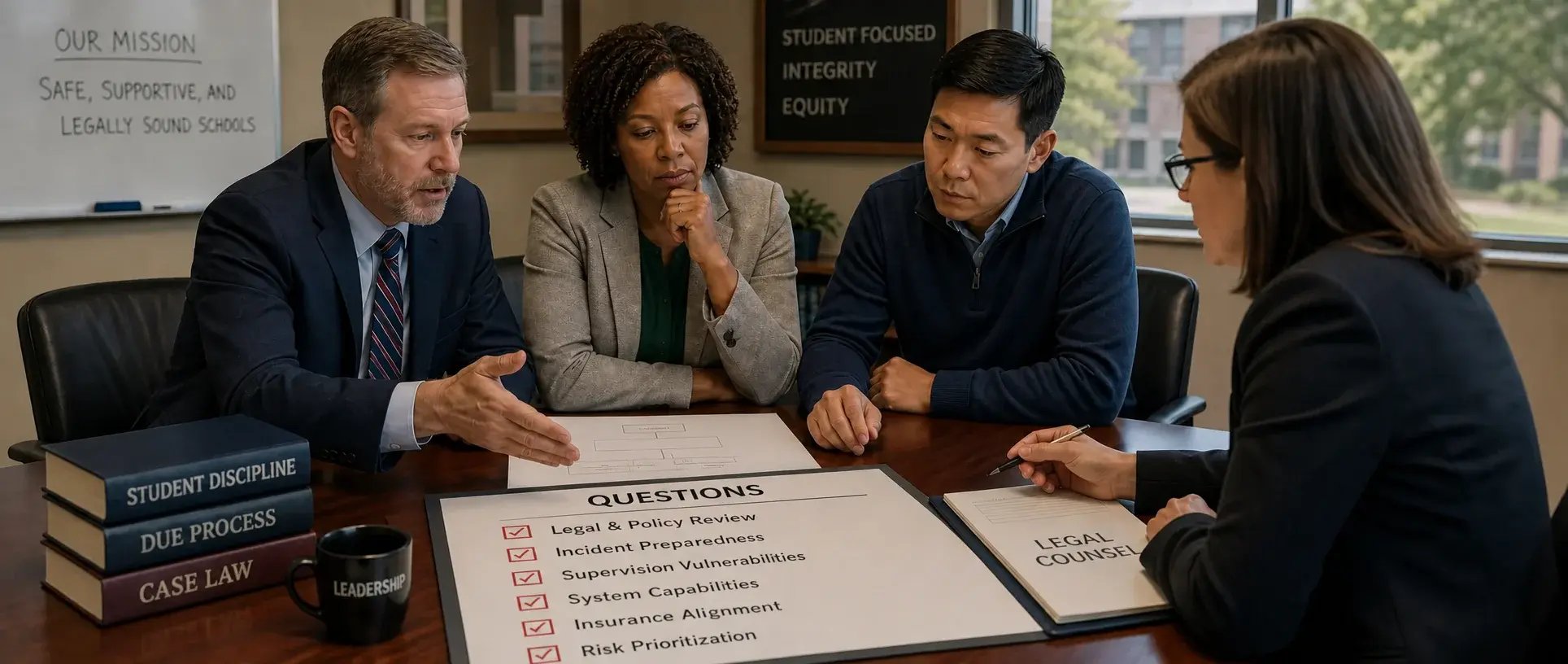
For administrators working through SB 848, a few questions tend to be productive starting points. None of them require a technology purchase. All of them inform what a district’s response might look like.
These are conversations worth having internally before they are conversations worth having with vendors or integrators.
 Where the Conversation Goes From Here
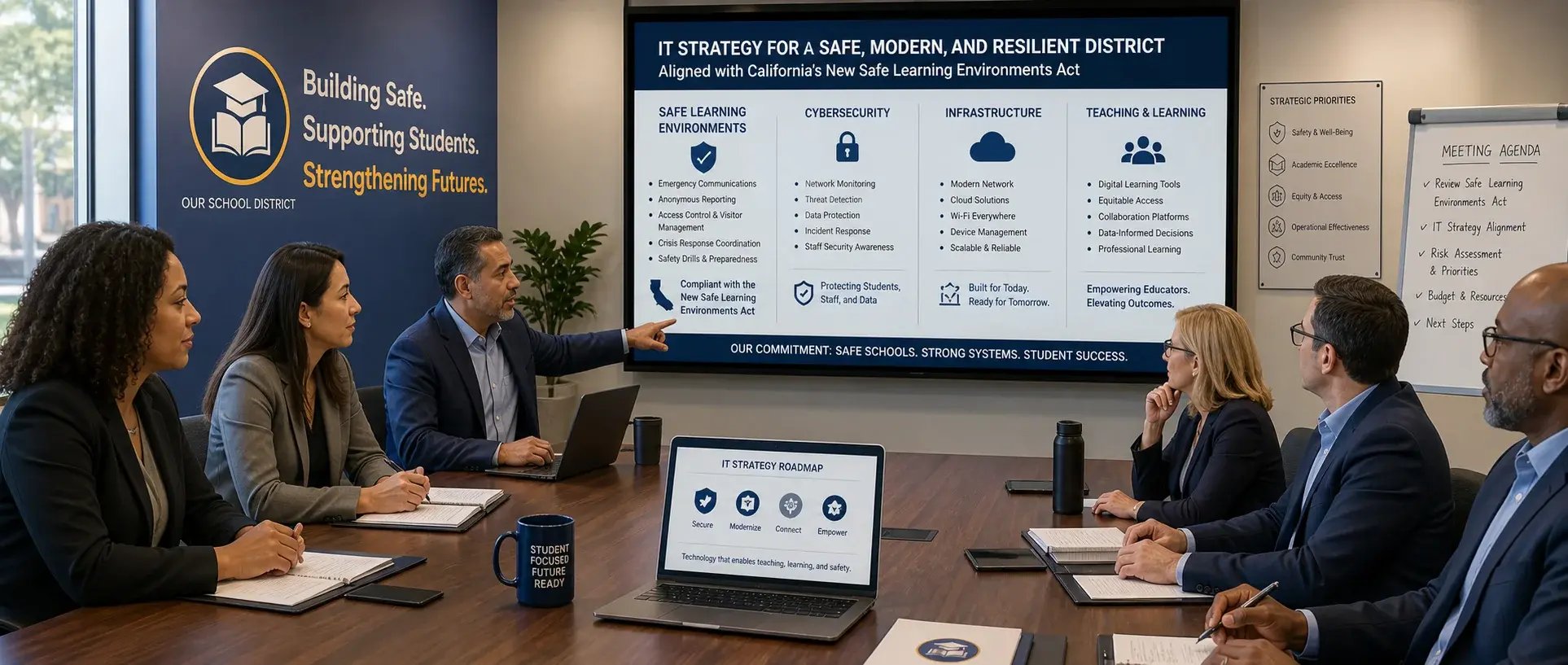
SB 848 will continue to evolve. Some provisions will become clearer through guidance from the California Department of Education and the Commission on Teacher Credentialing. Others will be tested in practice as districts implement them. The broader campus safety landscape will keep moving regardless, driven by technology change, liability pressure, and community expectation.
For district leaders, the most useful posture is informed, deliberate, and unhurried. The law is real, the deadlines are real, and the operating environment has changed. None of that requires a panic response. It requires a clear-eyed look at where a district is, where it wants to be, and what realistic steps connect the two.
A Note for District Leaders Evaluating Their Position
If your team is working through SB 848 and wants to better understand the technology landscape, NIC Partners offers a focused Supervision Technology Assessment. The assessment is technology-only and looks specifically at the four supervision categories outlined above: visibility, digital boundaries, private space detection, and evidence integrity. It is structured to fit a compressed timeline and is conducted primarily through interviews and review of materials the district can provide.
The assessment does not advise on policy, procedure, or legal compliance. Those conversations remain with the district, its counsel, and its risk pool. The assessment focuses on what the technology environment looks like today and where the gaps are, so the district can make informed decisions about what, if anything, to change.
This guide is provided for educational purposes. It does not constitute legal advice. Districts should consult with qualified counsel and their JPA risk pool partners regarding compliance with SB 848 and related laws.